
ICHION CONTEMPORARY
Shuji Mukai: “EVANESCENTIA”
【Dates】
Tuesday, October 6–Saturday, November 14, 2026
【Opening Hours】
11:00 a.m.–6:00 p.m. (last admission at 5:30 p.m.)
【Closed】
Sundays, Mondays, and public holidays
【Admission】
Free
【Overview】
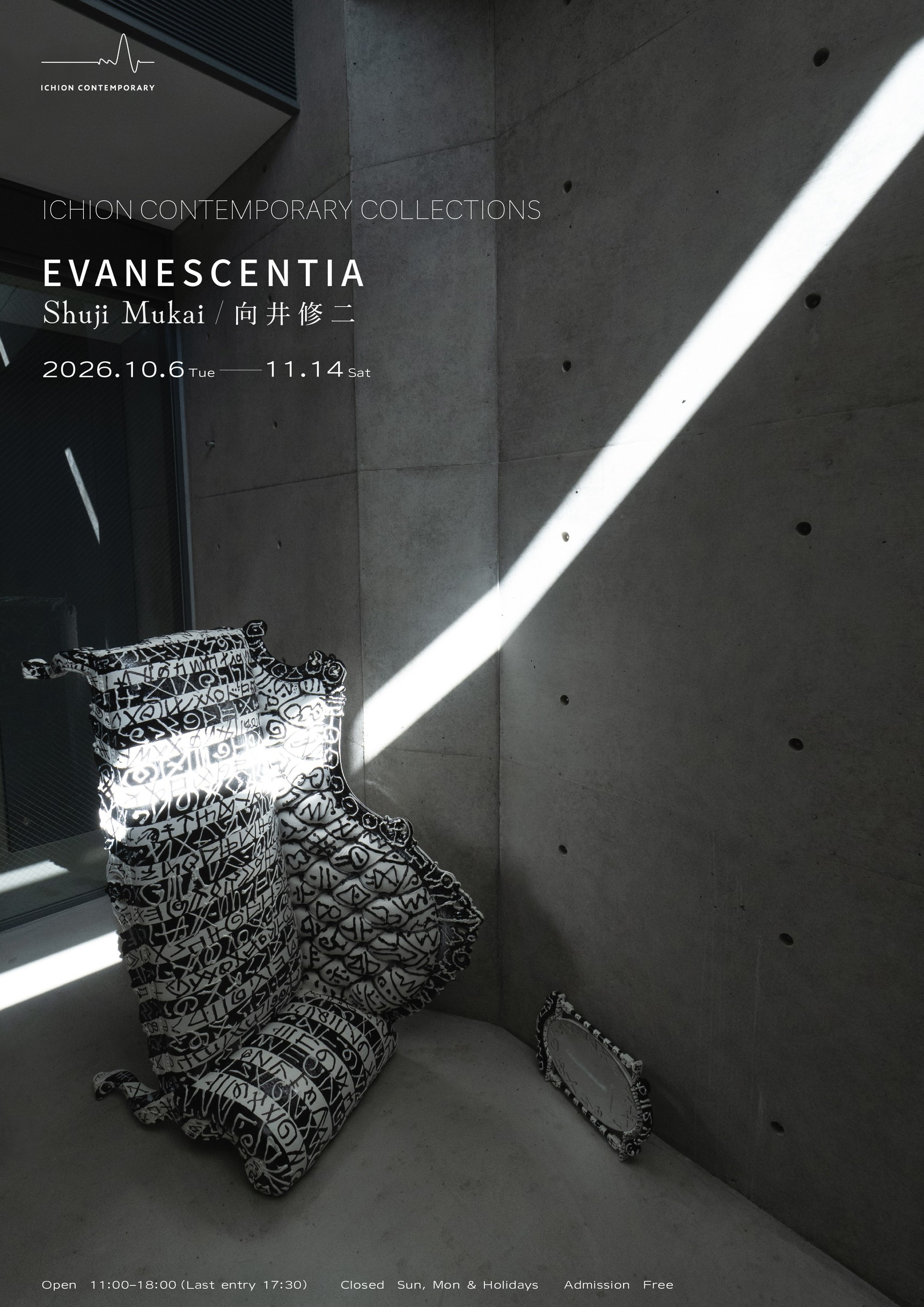
ICHION CONTEMPORARY, a contemporary art gallery operated by Art Distribution Support G.K., will present “EVANESCENTIA,” an exhibition of works by Shuji Mukai, from Tuesday, October 6, through Saturday, November 14, 2026. The exhibition is part of the gallery’s collection exhibition series, “ICHION CONTEMPORARY COLLECTIONS.”
In 1959, while studying at Osaka School of Fine Arts, Shuji Mukai encountered Jiro Yoshihara, the leader of the Gutai Art Association, who recognized his talent. In 1961, Mukai became the youngest member of the Gutai Art Association. Yoshihara described his work as “seemingly cool at first glance, yet containing tremendous energy within.” From the early stages of his career, Mukai developed a distinctive practice of repeatedly covering the picture plane with signs that carried no specific meaning. He subsequently expanded this practice to objects, architectural spaces, and even his own body. In 1966, he participated in “The New Japanese Painting and Sculpture” at The Museum of Modern Art, New York (MoMA), which continues to hold his 1963 work *Untitled* in its collection.
The Gutai Art Association pursued a wide range of experiments not limited to painting, involving materials, the body, actions, time, and space. The installations and performances undertaken by its members were not necessarily practices separate from painting; they also questioned painting as a form in itself and sought to expand its possibilities. Mukai’s practice is likewise deeply connected to this exploration of the nature and potential of painting.
At the 10th Gutai Art Exhibition in 1961, Mukai presented *Room of Symbols*. In this work, everything from the furnishings of the room to the artist’s own body was covered with signs, while Mukai himself occupied the space. Painting thus extended beyond the two-dimensional picture plane into a real space that incorporated the human body itself.
Mukai subsequently presented *Work-Burning Happening*, in which he threw his own works into flames, transforming painting into an environment. Yet he did not abandon painting. Instead, he released his signs from the picture plane into the realm of everyday life. In 1966, he covered the jazz café Check in Umeda, Osaka, with signs—from its walls, furniture, and tableware to the people working there—transforming the work into a space to be experienced together with music, food and drink, and human interaction. This intervention into real space has continued to the present, extending to a variety of locations, including the Solomon R. Guggenheim Museum in 2013, the Hyogo Prefectural Museum of Art in 2014, Louis Vuitton SoHo in New York in 2017, and the Nakanoshima Museum of Art, Osaka, in 2022.
Mukai’s signs are not symbols intended to point to or represent something. Rather, through the physical act of drawing them repeatedly and in vast numbers, they neutralize the functions of signification and classification that signs conventionally perform, thereby unsettling established distinctions and boundaries. When signs cover objects and spaces, the systems of names, functions, and values that previously defined them begin to dissolve, and the question “What is this?” emerges anew before the viewer.
The title of this exhibition, “EVANESCENTIA,” is a Latin term meaning “disappearance” or “evanescence.” Its meaning is closely aligned with the exhibition’s central perspective: through Mukai’s signs, the meanings and values previously assigned to things disappear, opening the way to new forms of perception.
The exhibition will present a group of works, including objects, in which Mukai’s signs have detached things from their established meanings and functions. These works will be installed within the architecture of ICHION CONTEMPORARY designed by Tadao Ando. The exhibition also constitutes an attempt to dismantle the order of the “room” that has shaped our familiar everyday lives within the gallery space. Here, the works do not exist in isolation; rather, they acquire new meanings through their relationships with the architectural space and with the viewers who enter it.
Although Shuji Mukai’s sign-based practice is situated within the lineage of postwar Japanese avant-garde art, it has continued to respond to different periods, architectural settings, and social spaces, constantly renewing its field of possibilities. We hope that visitors will enter this exhibition space, where established meanings have disappeared, and encounter the essence of Mukai’s practice through the new perceptions that emerge for each individual.

Member Sign In